During my stay in the UK, I’ve heard many things about my culture from British people. I liked that because it gave me the opportunity to recognize how people view my culture from the outside. I remember some British people asking us foreigners what we thought of them, how we felt people viewed us, and the most recurring topic of ‘What do you think of our food?’ I remember I was asked this question very early in my stay there to which I replied ‘What is your food? I know nothing about it. The restaurants I see all offer either Indian cuisine or Italian cuisine.’ After staying there a while and trying Jamie Oliver’s restaurant, I understood why the topic of British food was a hot one.
Anyways, I enjoyed cultural topics (for the most part). What I don’t like about them is that these topics tend to reinforce stereotypes. One stereotypical topic about Arabs is that we don’t read. One story someone told was that he was on a bus in Oman and he asked the person next to him why he is not reading a book. That person replied with a laugh and said ‘If I am to read, I’ll read the Quraan.’
In my opinion, talking about Arabs not reading to an Arab PhD student is an oxymoron intrinsically. How can one do PhD work without reading? But let’s assume that what Brits talk about is the majority of Arabs and not those who move on to be PhD holders.
I did not like that topic, but I never said anything when it arose, nothing. I did not confirm it and I did not deny it. However, I believe that me not saying anything is confirmation enough for them.
If we really did not read, then who is reading the large number of books printed every year in Arabic?
Do Arabs really not read? I’d like to answer this question from two vantage points: a cultural one and a linguistic one. But first let me introduce you to my own story with reading, and let me assure you that I believe that I am an average reader. I don’t consider myself an avid reader. For example, in the past month, I read two books and started three others (I don’t wait to finish a book in order to start a new one, which leads to me leaving books unfinished).
My story with books
My story with books began way before I was born. You see, my father grew up as an orphan. He had a difficult childhood and couldn’t go to school at the usual age kids at his time went to school. He told us that he wanted to learn and educate himself that he used to buy books before he even learned to read. He kept them thinking: ‘One day, I’ll go to school and read these.’
Now, let’s unpack this story for a second. My father grew up in a time when most people were poor, they struggled to afford food and clean water for their kids. This was before oil revenues were exploited to build the country and before the status of living improved for Saudis. Putting this situation in mind, we still find people selling books at the side walks, where my father told me he bought his books from. Those people must have been aware of a market for their merchandise. So even when people were poor, there were people who valued books and valued reading.
My father did go to school later in his life and was blessed with the ability to read those books he purchased. He later on worked as a librarian! He used to read on a daily basis for hours. I grew up in a house where three rooms were converted to libraries to hold the growing number of my father’s books! My father loved reading and he instilled this into us. But not only that, he taught us to be gentle when we read a book and not to force the book wide open. He did not like that people would write on books or underline things or even fold the tip of the page to find it easily later on – to him, a book must be treated with respect.
When my father’s eye sight deteriorated as he grew older, I used to read to him. I read for my father almost everyday before I got married and left the family home. Sometimes, my father would ask me after I finish reading to him: ‘What did you get from this book?’ He wanted me to read critically. Oh how I wish he knew that I ended up with a PhD thanks in part to the way he raised me.
I used to read to him in Arabic books that were mostly religious, but some geography and history, too. At the same time, I used to read classic English novels for myself. However, because I couldn’t get my hands on lots of English novels, I used to read the ones I liked again. I’ve read Pride and Prejudice and Jane Eyre three times, and I’ve read The Mill on the Floss two times. I’ve also read other novels twice like Mrs. Dalloway and The Old Man and the Sea.
After getting married and having kids my repertoire of read books per month decreased. Now that I am older and my kids are all teenagers, I’m back on the reading horse again, but I find myself with zero tolerance to novels, and I feel that my time is better spent reading books related to my work as a linguist or to books that are mainly religious, geographical, or historical in nature. The same types of books I used to read to my father.
Now that you know what my relationship with books is like, I’ll move to why westerners think that Arabs don’t read. I need you though to put in mind that anecdote of a Saudi girl who is not at all atypical.
Arab culture towards reading
As I explained earlier, I took my love of books from my father, I cannot write on books, I cannot fold the tip of the page, and I try not to look when someone around me is folding the pages to hold the book in one hand as in the AI generated picture below shows.

If I had to make notes on some pages as when I am teaching, I would use sticky notes instead. However, the general culture towards books, I took from both parents. My father as much as he loved reading, refuse to display books in the living room or in the guest room where we had a large shelve unit with ornaments and different items displayed but not books.
I believe this is an important factor that contributes to the belief that all Arabs don’t read. We like to keep our books hidden for different reasons. I’ve talked about this with a number of people, each giving a different reason for not displaying books in guest rooms. Some said: if your guests saw your books, they might ask to borrow them, next thing you know, your books are scattered in different houses and you cannot get them back. Some would say that books are ugly. I feel for them. If you purchased books for the way they looked, you’re purchasing them for the wrong reason. Books come in different sizes, colors, and materials and it’s hard to display them neatly in a place used mainly by visitors. A third reason I came across is that books are precious collections, and you don’t keep your jewellery and precious items displayed for everyone to see. O. K. Fair enough. Whatever the reason, there is a general consensus not to display books in places where visitors are expected.

Another contributing factor to the Arabs don’t read myth is that it’s considered rude to read in the presence of people around you, especially people who you’re not living in the same place with. I learned this from my mother, first; but then I noticed this to be common knowledge in our culture. When you’re reading with people around you, you are excluding yourself. It’s as if you are saying to them, I’m not interested in engaging with you in any conversation. This is similar to turning the radio on in a car when there are people with you. It’s as if you are saying let’s just not talk.
I believe that this is why the people in the bus found it odd to read a book on the bus. Because it’s rude to the person next to them. (This rule, however, is broken now with the advent of social media. Now you find people absorbed in their mobiles even though they are sitting in a room full of people.)
It is important to note that our culture around books generally don’t apply to reading the Quraan, we display it proudly in our living rooms as an invitation for people to pick it up and read because reading the Quraan is in itself a worship act that we are rewarded for. So people who read the Quraan in a bus or as they are waiting for something are highly regarded by the people around them. Still, reading the Quraan when one is expected to be social is still rude and is considered hypocritical.
The Arab culture around books (don’t display them and don’t read them around people) can cause people unaware of this cultural norm to think that we do not read. There is a linguistic factor at play, too.
What is a Book
Linguistically, the word book in Arabic is kitab and it generally refers to the same sense the word ‘book’ refers to. However, what we refer to when we use this word is more restricted than what is referred to by the English word ‘book.’ First, small books are not kitab they are kutayyib (lit. Little book). Second, stories are not books. I know that the English word book can refer to a novel. I realized this when I lived in the US for a while. I noticed that people would say ‘I read two books last month’ and when you asked what these books were, they would give you names of novels. To tell you the truth, this came as a surprise to me. I would never call a novel a book. A book is reserved for information books to us Arabs (In fact reading novels is somewhat viewed as inferior). And thus a person who only reads novels would answer the question ‘Do you read books?’ with a no and would answer the question ‘Do you read?’ with ‘only novels’. I’ve come across this a lot with native speakers of Arabic. People who are English/Arabic bilinguals don’t have this separation of a novel vs. a book, though. But don’t take my word for it. Let’s see some authentic corpus data.
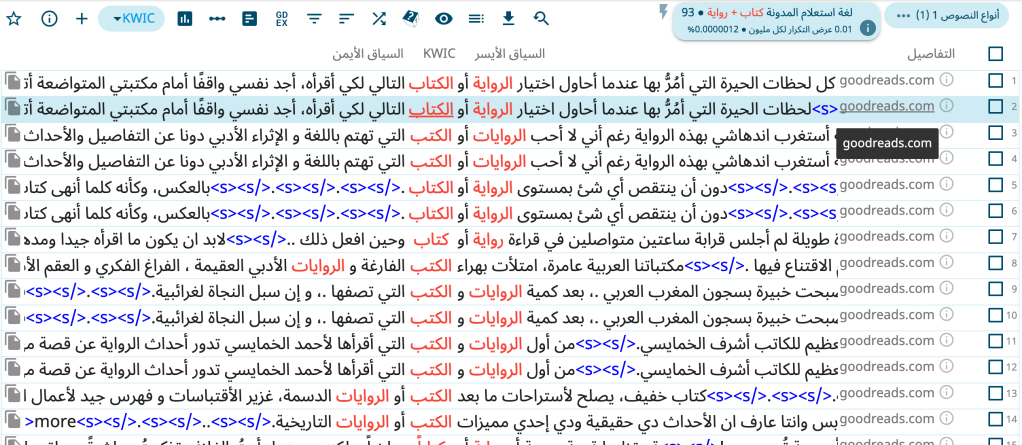
In the two screenshots above and below, we see how the two words ‘book’ and ‘novel’ are treated as two distinct entities. For example, the sentence number 81 that appears in the screenshot below reads as follows:
Please visit my instagram page in which I review novels and books.

In fact, there is a growing trend that I observed on x.com that people are defending reading novels saying that ‘reading novels IS reading’ and that you can benefit from them. This trend calls for consideration of reading novels. People who were previously shamed for being readers of novels are taking a stand and saying that there is nothing shameful in that and that they should be considered as readers of books just like other readers. The mere fact that these people are saying that on X reveals a lot about the cultural and linguistic background behind this topic. I share with you some screen shots of their posts with translations of parts of them.
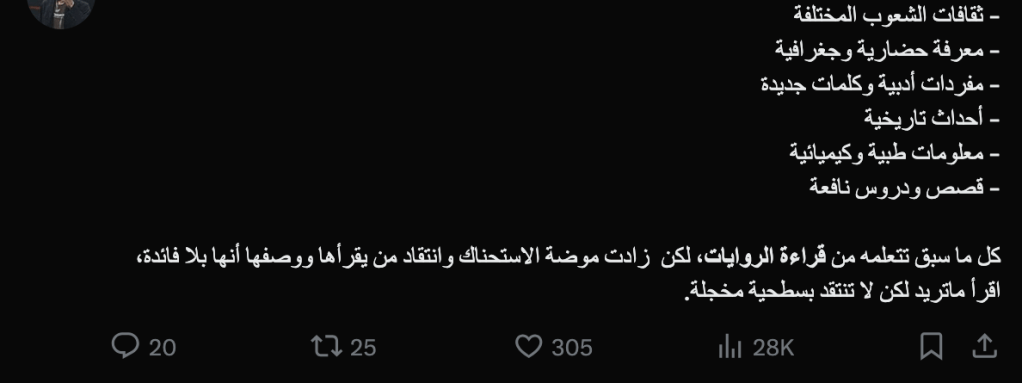
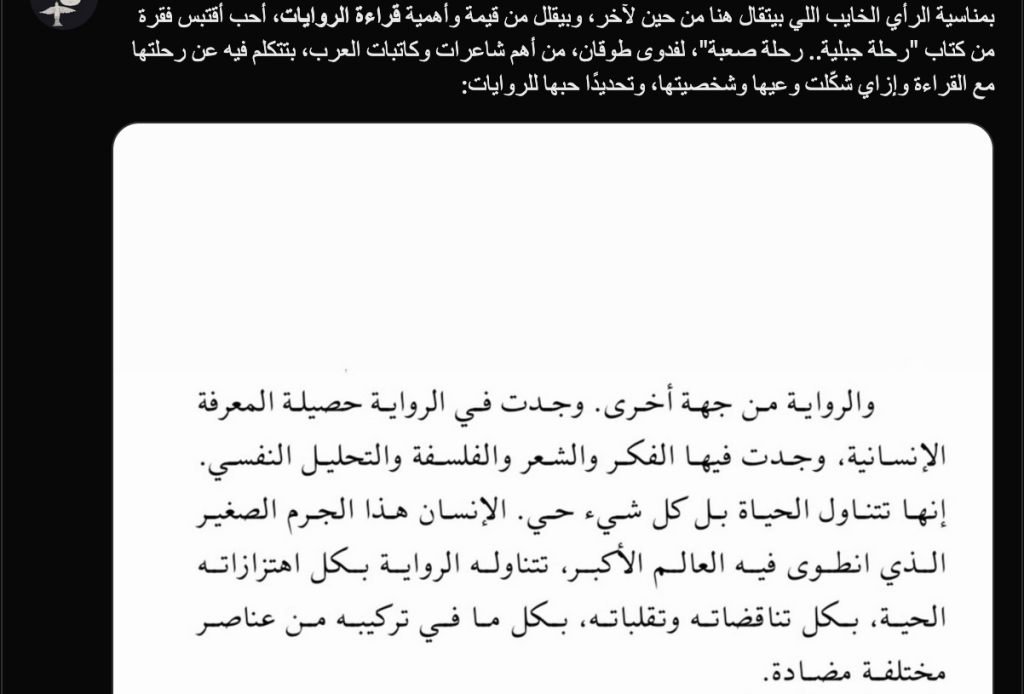
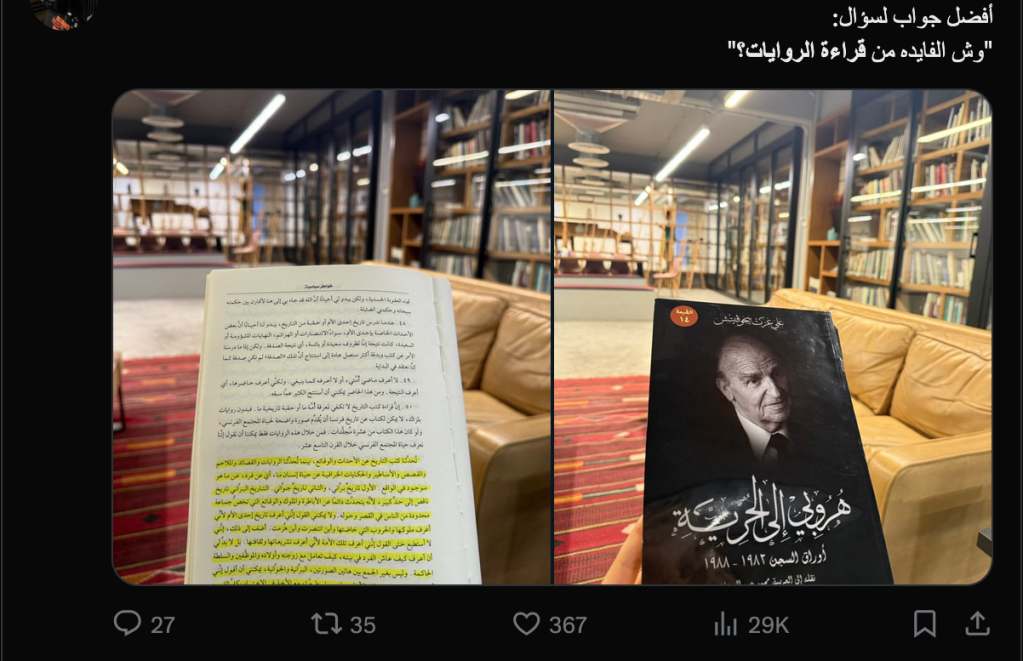
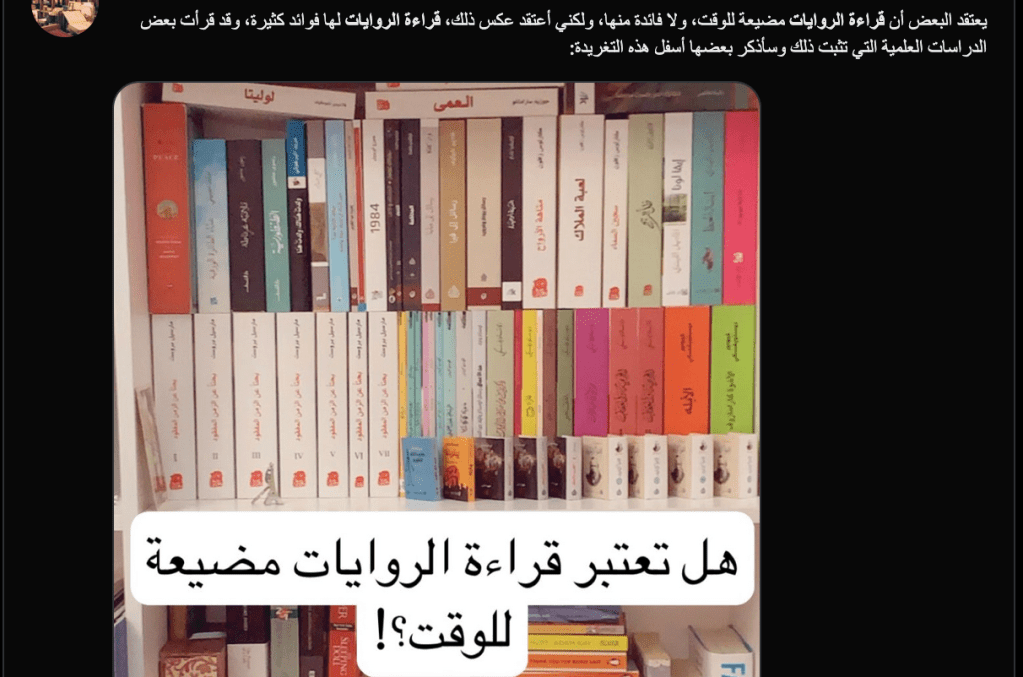
In what follows, I sahre some screen shots of the opposite side of the debate. Here we see people saying things against reading novels.


An important cultural aspect that needs not to be ignored is that a lot of people do attend religious lectures on a regular basis. People giving these lectures prepare their material from books and many people gather to learn from them. Sometimes these lectures take the form of reading a book in which one person reads a book and stops in intervals to explain some aspects of it (sometimes the person who reads is different from the person who explains). Do we consider the people who listened to the book being read to them as not readers? Isn’t an audio book a book? If you ask these people they would say they don’t read. But they do attend lectures in which books are read out loud. The culture of lectures being attended in person, or listened to on the radio or recorded online (or on cassettes in days gone by) is not found in the west. If you are to statistically count the people who read and those who don’t, how are we to quantify the group of people who do not read by themselves but extensively attend such lectures? They are aware of information and stylistic features present in these books that none readers are not, but they do not consider themselves as readers.
Now that these cultural norms related to reading are explained, we need to put in mind that people are never satisfied with the percentage of readers in their society. I don’t know why that is, but when you talk to people, Arabs and none Arabs alike, they always think that people don’t read as much as they should. I have heard this complaint from some fellow Arabs and I’ve heard it from Brits, too.
 لسان ولغة